- Evidently
- Posts
- Customer advocacy isn’t a vending machine
Customer advocacy isn’t a vending machine
Why one-way advocacy “programs” quietly fail and what actually makes people show up

Mark Huber
February 04, 2026
I used to think I had a customer advocacy program.
What I really had was a bunch of one-way asks that worked just enough for me to convince myself it was working. I’d ask for a reference call. Or a quote. Or a case study.
Sometimes people said yes. When they did, I’d get the work done, call it a win, and move on to the next ask. Almost like a vending machine.
The thing I didn’t really stop to think about was why anyone would want to keep doing that.
People have jobs. Real ones. They’re busy. They’ve got pressure, priorities, and their own reputations to worry about.
And if the only side benefiting from an “advocacy program” is the company, it’s not really a program. It’s asking for favors and hoping goodwill carries you far enough.
The moment you find yourself pitching customers on why an advocacy program is worth their time, something’s off.
If it were actually valuable, you wouldn’t need to explain it.
What clicked for me was that customer advocacy only works when both sides actually get something out of it.
So instead of asking, “How do we make this easy?” I started asking, “What would actually make this worth your time?”
Maybe that’s making introductions that help them. Maybe it’s getting them on a stage. Maybe it’s featuring their thinking. Sometimes it’s literally just asking what they’d want out of something like this and then building around that.
Once I started doing that, everything got easier. Response rates went up. Conversations felt different. People showed up because they wanted to, not because they felt obligated.
That’s when it really clicked for me: getting something from customers isn’t advocacy. Building something they want to be part of is.
How advocacy actually breaks
Once you see advocacy as something that has to give value back, you start noticing how it actually breaks.
Not with drama. Not with conflict.
Replies take longer. Meetings get rescheduled. Someone says yes, but what they send back feels thin.
At the time, I didn’t read this as a relationship problem. I read it as something we just needed to fix. People are busy. Things slip. I’d follow up once or twice and move on.
But over time, a pattern set in.
The enthusiasm wasn’t there anymore. The conversations felt transactional. And eventually, people didn’t stop helping — they just stopped responding.
Most people don’t push back when advocacy breaks. They don’t complain. They don’t say they’re done. They just disengage quietly.
From the inside, it’s easy to convince yourself this is an execution issue. That you need more advocates, more asks, more follow-ups.
From the other side, it feels like a steady stream of small requests that never really add up to anything for them.
Each ask makes sense on its own. That’s what makes this so hard to spot. There’s no obvious moment where it goes wrong. It just slowly stops feeling worth it.
That’s when advocacy becomes fragile. It technically exists, but it only works when conditions are perfect. And the moment you actually need it, it’s gone.
Why it feels fine until it doesn’t
This is the part that fooled me the longest.
Nothing was obviously broken. People still said yes. Work still got done. Deals still moved. If you looked at things in isolation, everything seemed fine.
Each ask felt reasonable. Each one delivered something useful. And because nothing blew up, I kept going.
But over time, the job started to feel different.
I found myself hesitating before asking. Rewriting messages to sound lighter. Wondering who I’d already leaned on too many times. Paying attention to who responded quickly and who didn’t.
It’s because it never really worked in the first place. It was running on goodwill.
And goodwill is finite.
Clarity is about trust, not control
Once reciprocity is there, clarity starts to matter in a different way.
When an advocacy ask is vague, all of the risk sits with the customer. If they don’t know how often they’ll be asked, how much time it’ll take, or where their name will show up, they have to assume the worst.
Not because they’re cynical. Because they’re protecting themselves.
I’ve been on the other side of that too. The moment someone says, “We’ll figure it out as we go,” or “We just want your authentic voice,” you can feel the uncertainty creep in. Not because you don’t want to help, but because you don’t know what you’re actually signing up for.
Authenticity without constraints doesn’t feel freeing. It feels paralyzing.
The best advocacy experiences I’ve had were clear from the start. What this is. What it isn’t. What’s expected. What’s optional. How long it lasts. When it ends.
That kind of clarity doesn’t make advocacy rigid. It makes it sustainable. It lets people opt in with confidence instead of hesitation.
The moment someone starts to feel like an asset
Another place advocacy quietly breaks is when customers stop feeling like partners and start feeling like marketing assets.
You can feel the shift when it happens.
The conversation changes tone. Drafts show up already written. Feedback turns into approvals. The space to think or push back disappears.
I remember rereading something I’d been asked to put my name on and realizing I wouldn’t recognize my own voice in it if my name weren’t attached. That was the moment I knew something was off.
That’s part of why I stopped doing one-off paid posts a couple years ago. Not because payment is inherently bad, but because it became obvious when something didn’t sound like me anymore. It sounded like the company.
And anyone reading it could tell.
The teams that get this right don’t try to control the message. They trust the person they’re asking. They share context instead of copy. Guardrails instead of scripts. They leave room for nuance.
If someone is willing to put their name and personal reputation behind your product, flattening their voice is the fastest way to lose them.
What actually earns a yes
A lot of teams default to incentives as the fix. Gift cards. Merch. Physical gifts.
Those things can help, but they’re rarely the reason advocacy programs actually work.
What matters more is whether being associated with your brand feels worth it in the first place.
Whether showing up does something for them beyond the immediate ask. Whether it helps how they show up in their own role, or how they’re seen internally.
When someone said no, my instinct used to be to figure out how to change their mind.
At some point, I realized that was the wrong reaction.
A no usually wasn’t about the person. It was about the setup. It was telling me something about whether what I’d built was actually worth showing up for.
Once I started paying attention to that, a lot changed.
The best advocacy relationships don’t rely on pressure. They don’t assume participation. They make it easy for people to step in when it makes sense and step back when it doesn’t.
And when someone does say yes in that kind of setup, you can feel the difference. The energy is there. The quality is there.
That’s what real customer advocacy feels like.
A concrete example
This is also why I’m a lot more comfortable with paid advocacy when it’s done this way.
Yes, we paid Brian LaManna for this post. We’re running a three-month paid influencer marketing pilot. But Brian is also a customer, and he actually uses UserEvidence every single day.
That part matters more than the payment.
If you read the post itself, it doesn’t feel like an ad. It feels like Brian sharing something he genuinely does in his job.
That’s the whole point.
He wasn’t handed a script. He wasn’t told what angle to take. And he definitely wasn’t coached on how to make it sound more “on brand.”
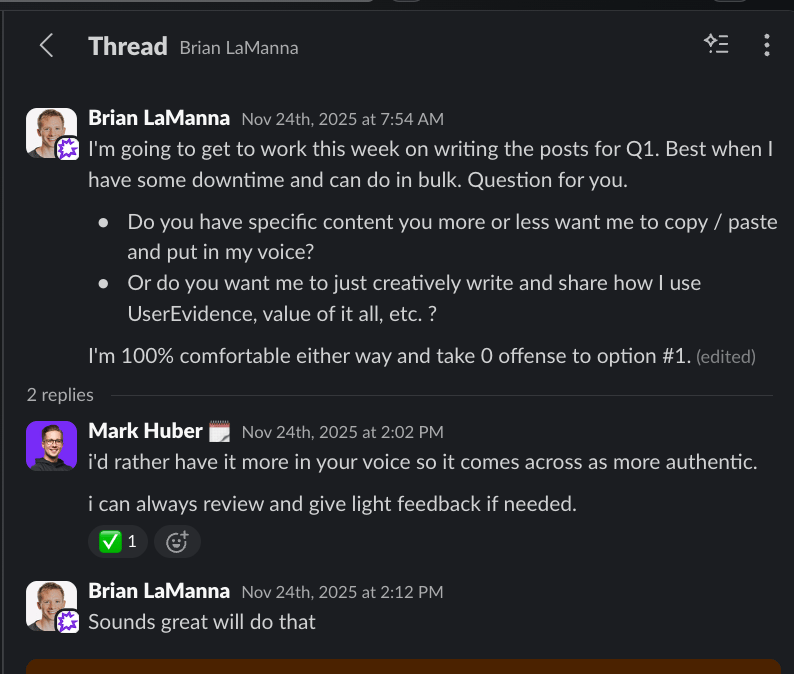
This was the entire setup we agreed to.
You can tell when someone is sharing something because they want to versus because they agreed to. One reads like performance. The other reads like practice.
This was the latter.
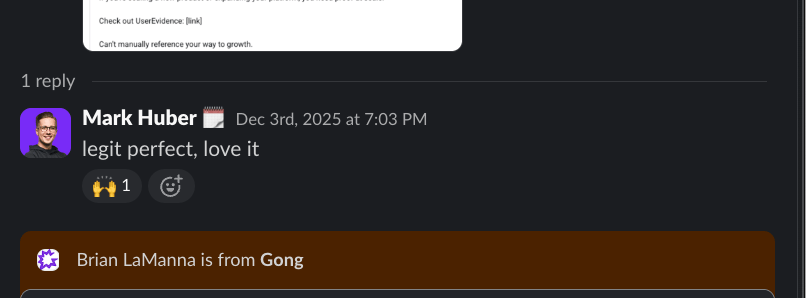
And here’s what “light feedback” actually looks like.
That’s not me being hands-off for the sake of it. That’s trust.
Brian didn’t need polishing. He didn’t need guardrails. And he didn’t need us smoothing anything out.
We paid him to do it. The reason it worked is because he didn’t have to fake anything.
That’s the difference.
When advocacy is built around the person instead of the ask, you don’t have to force it. You don’t have to over-edit it. And you don’t have to convince anyone it’s worth their time.
Then your advocates show up and nail it on their own. And that’s what customer advocacy looks like when it works.
Stuff I’m digging this week
Where to start with UserEvidence—We keep hearing the same thing from our customers: everything feels urgent and no one knows where to start. This is the path we keep coming back to because it’s the fastest way we’ve seen customer marketing stop feeling like a five-alarm fire.
Jason Lemkin’s Inference is the New Sales & Marketing Spend—I almost stopped reading this post because it made me feel behind. Then I kept reading and realized that feeling was the point. The B2B companies winning right now are dumping money into making the product so good and so fast that the rest of us end up talking about it for them.
Rippling's Super Bowl commercial with Tim Robinson—I’m not saying everyone should copy this. Mostly because 99.9% of us don’t have Rippling’s marketing budget. I just loved that Rippling was willing to be weird and memorable in a category where most marketing is safe and forgettable.
Hold up—what does UserEvidence do again?
Most companies have great customers. What they don’t have is a way to activate them.
So the stories, the insights, and the people who would actually help end up scattered across decks, tools, and Slack threads. Things get messy. Quotes get lost. Advocates get overused. Deals slow down.
UserEvidence fixes that.
We give your GTM team one platform to activate your customer base. You can find new advocates, capture customer proof, and publish original research— then use all of it where it actually moves the deal forward.
Advocacy — Activate your best customers without burning them out.
Evidence — Verified, believable stories and results buyers actually trust.
Research — Original long-form research content that shapes your narrative.
UserEvidence helps B2B marketing teams make it easier for customers to show up authentically when trust matters most.